CCM19 Integration Options
There are three possible ways to use the CCM19 Cookie Consent Tool. In principle, the tool is designed to prevent certain scripts from running until the visitor has given consent for them to run.
These scripts can store cookies, local-storage-elements, or other objects in visitors’ browsers, or otherwise read data. We will not go into the legal background here; this section focuses exclusively on the technical implementation.
Each of the three options can reliably block the execution of the scripts. Options 2 and 3 also effectively prevent scripts from being preloaded. However, these are somewhat more complex to implement.
The basic prerequisite in each case is that the CCM19-Code-snippet has been integrated into your page—this step is explained here.
Please select only ONE of the three methods to use!
Option 1 - Script-Blocking
This is the standard-option, which is also used during the onboarding-process. The CCM19 scanner analyzes your page and identifies which scripts are being used. The content of your banner is then generated based on this information.
All you need to do is integrate the script-/HTML-snippet from CCM19 into your page; you can manage the rest via the user interface.
From a technical standpoint, CCM19 prevents theexecutionof the scripts until consent for their execution is granted. In the "Integrations & Cookies" section, under the "Block scripts containing the following text" field, you can view the blocking strings that prevent the respective tools from running. This list can be customized as needed if blocking does not work with our standard-values.
Under certain circumstances—for example, due to async-attributes in the script-tags—scripts may still be loaded by the browser but not executed. If this loading alone sets cookies or results in data being transmitted to external servers, it can lead to data protection issues. Therefore, you should always check afterward to ensure that no cookies that are not technically necessary are set before consent is granted.
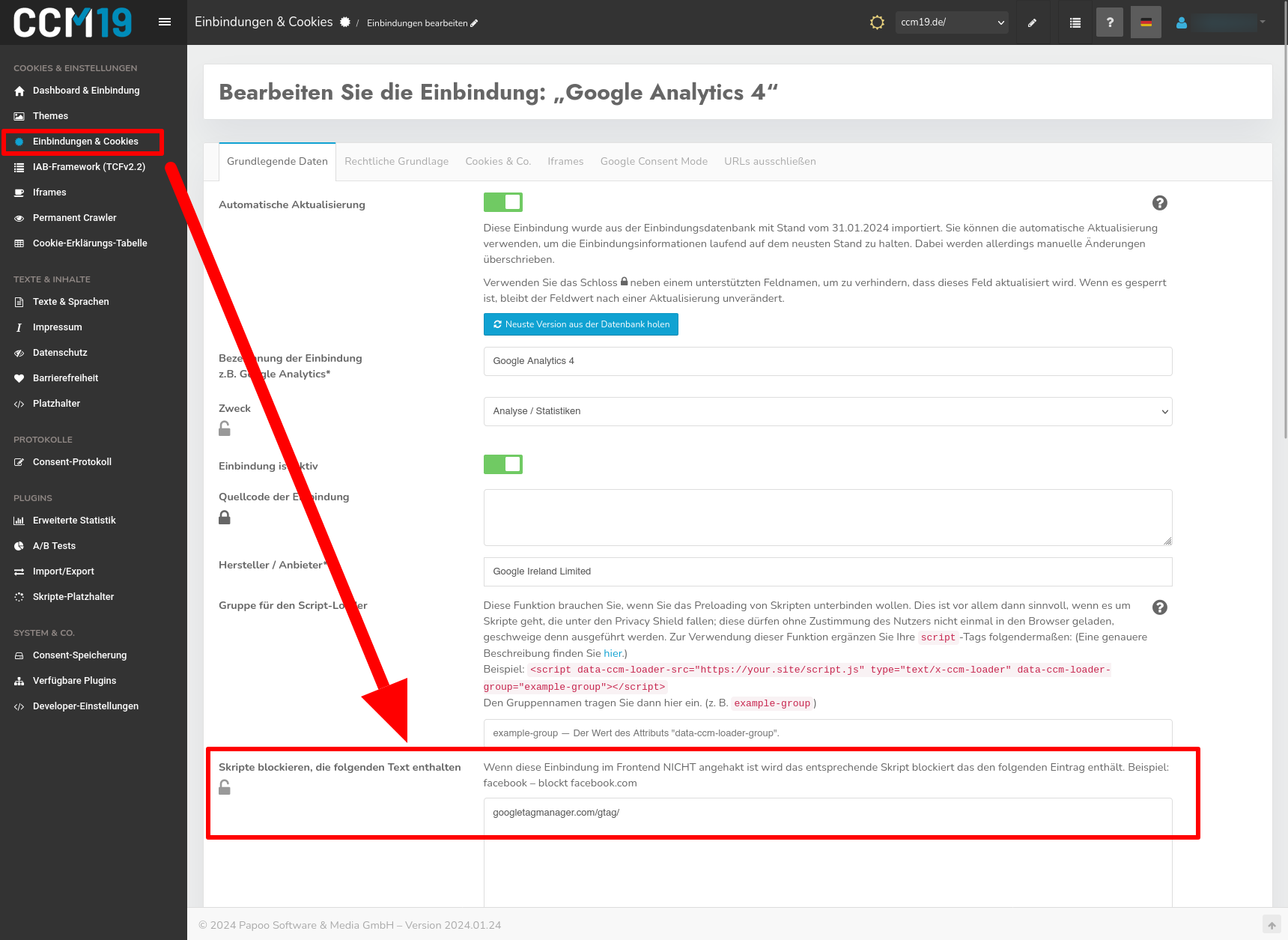
Important Note: Only scripts that appear in the source code after the - snippet from CCM19 can be blocked. Therefore, it is important to place the CCM19 - script as high up in the head section as possible.
Option 2 -: Tag Manager Functionality
You can use CCM19 as a tag manager that manages the scripts within CCM19 and only loads and executes them after consent has been given.
To do this, enter the HTML-code—for example, the Google Analytics script—into the “Embedding Source Code” field in CCM19 for the appropriate integration, and remove that code from your page’s HTML. Where and how you do this depends on your CMS or e-commerce platform. In most cases, these scripts can also be disabled via the CMS interface.
CCM19 will integrate the stored script into the page as soon as consent for the integration is granted. This means the script no longer needs to be embedded in the page itself, and it ensures that it is never executed without consent. This method also has the advantage of potentially improving the page’s loading speed, since scripts only need to be loaded when consent has been granted.
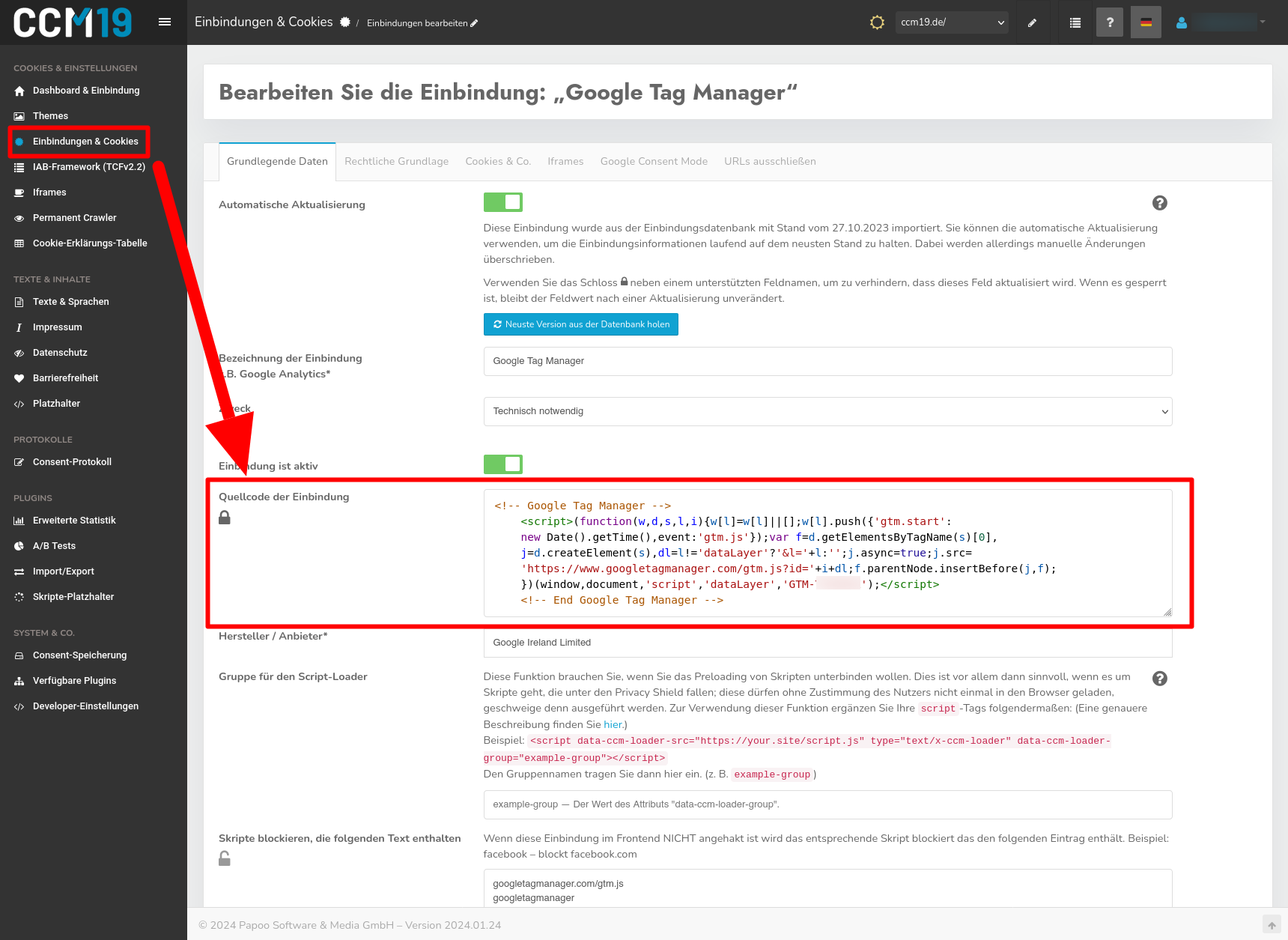
Please note that this implementation may trigger warnings and/or error messages in the tools you use, indicating that code is missing from the page. These messages can be ignored because the code was intentionally removed from the page’s source code. Unfortunately, most tools do not recognize that the code is added after consent is given.
Option 3: Modifying the HTML-via -
Alternatively, you can block scripts directly in the website’s source code and, upon the visitor’s consent, enable and execute them via CCM19. This option is available for both inline-scripts and external scripts. The general procedure is as follows:
- The
type-attribute is replaced or defined as follows:type="text/x-ccm-loader" - For external scripts, the
src-attribute is replaced:data-ccm-loader-src
With this adjustment, a browser no longer recognizes the corresponding script as executable JavaScript-code and initially refrains from processing it.
CCM19 recognizes scripts defined according to this scheme and treats them like any other script. All rules defined for scripts in the CCM19-configuration for your domain apply.
Handle every script-tag on your website that is to be blocked, allowed, or reloaded according to this function. As an example, this might look like the following:
External script:
Inline-script:
```html```
Important Note: Modified scripts can only be reverted by CCM19 if they appear in the source code below the CCM19 code. Therefore, it is important to place the CCM19-script as high up in the section as possible.
Group for the Script-Loader
If you use the HTML-modification to block scripts on your website, you can group the affected scripts and enable them uniformly via a single inclusion.
To do this, define a group; you can choose the group name yourself—for the following examples, we’ll use example-group. The group is specified using the attribute data-ccm-loader-group .
External script:
<script data-ccm-loader-group="example-group"
        data-ccm-loader-src="https://your.site/script.js"
        type="text/x-ccm-loader"></script>
Inline-script:
<script type="text/x<nt>-</nt>ccm<nt>-</nt>loader" data-ccm-loader-group="example-group">
    // Your code here
</script>
Enter the group name in the relevant integration under "Group for the Script-Loader" to link the integration to the selected scripts on your website.

As soon as a site visitor allows such an integration, the grouped scripts are reloaded.
Technically speaking, CCM19 uses this type of integration to prevent the loading and execution of the scripts until consent for execution has been granted.
This option gives the user the greatest flexibility, as it allows for the control of individual scripts with special functions that, for example, appear only on a single page.
Note: Images are also supported; simply define the attributes data-ccm-loader-src and data-ccm-loader-group for the img tag. The attribute type="text/x-ccm-loader" is not required in this case.